Waiting

It can be difficult.  Waiting for a minute, for the other shoe to drop, for a phone call, for the light to change, for morning to come, for a day.  For the train to pass, test results, lab results, waiting for a week.  For your ship to come in, for weather to change, for snow to melt, for fields to dry, for healing to come, for strength to return, waiting for a month.  For it to rain, for construction to finish, for the mail to come, for fields to ripen, for a healing regime to finish, waiting for nine months.  For nine months, through morning sickness, through body changes, and through emotional changes.  Through nine months of hope, from not seeing but seeing changes, to seeing.

Waiting can be difficult, can feel like darkness, but it is not empty.  It can feel lonely, and maybe that is the most difficult part of waiting….the sense of being alone.  Believing that there is no-one who has felt like this before, that there is no-one who understands the situation, that the decisions that must be made are yours alone to make.    

As we near the middle of Advent, the second week, I think of Mary and wonder what her waiting felt like, was filled with.  Certainly she had an angel’s words to carry her through what could have been anxious moments.  But, it was a person who helped her to wait.  She turned toward her relative, Elizabeth.  A person who was also receiving a gift of new life.  Someone who was willing to receive the help of another as well as give shelter to another.  It makes me wonder if Mary and Elizabeth might have had other things in common, such as feeling rejected.  One for being pregnant without a husband, and one enduring a lifetime of being barren.  Wasn’t it wonderful for both of them to be on the inside of the conversation, instead of outside?  The commonality of companionship where preparation can be shared and enjoyed because you are with another, receiving the help that we need when we believe without seeing.

It is hard not to form expectations while we wait, but there are gifts in waiting even though they might be hard to find.  I think that waiting can deepen our development into more mature beings.  Waiting allows us to figure out why we are reacting the way we are, to continue with those reactions, or to make adjustments.  It may also give us a gift of focus.  Allowing us to see what is truly important to us and maybe helping us to even uncover our deepest desires so we can change course.  

So what do we do while we wait?  Might we not create a new Advent practice to more fully understand Mary’s experience of waiting?  Could there possibly be an invitation to be intentional?  Sitting at a long red light, being alert to those who wait with us?  To wonder about their lives and what they are leaving or going to?  To make a type of practice that we do with our children when we sit at the red light?  Can we discover ways to be mindful, to breathe deeply, to exhale fully as we wait?  Maybe we notice and turn toward those who we are with, or who are with us and appreciate them more fully.  Could we find ways to be more alert for possible encounters with a loving mystery?  Is there a way to welcome the waiting?

“I wait for the Lord,
My soul waits,
And in his word I hope;
My soul waits for the Lord
More than those who watch for the morning
More than those who watch for the morning.
Psalm 130:5-6
How Can Hope be Sewn so Late

This poem could be about mending clothes or it could be about our divided country, or our broken environment…so like fabric that has been torn.  I have a lot of concerns about the upcoming election and our environment.  I don’t feel as though I have the wisdom to “do” anything or much, and I wonder if we can afford to “go to bed”, or to let only the politicians find a solution?  What would happen if we each looked into our own “basket” and did a little mending?

______________________

Who will sit in stillness
When all the lights are dimmed?
Though tired, who will pick the needle up
And lay the fabric right
To patch or darn or mend?
   Who will say, “Do it now”?

My grandmother sat late at night
Silence all around.
Pulling threads with calloused fingers,
Adding her strength to fabric,
So clothes could still be worn.
   Who will say, “I will help”?

Who will stitch the patches now,
Where fabric’s weak and torn by rough duress?
Or seams that parted by weakened thread?
Who will stitch because of love
for person or the craft?
   Who will see the “us” in “them”?
   Who will say, “I forgive”?

If only the stitch was made
When fabric first was torn.
But now the basket’s full
And first tear forgotten how.
   Who will say, “Reconcile”?

We must pick up the thread and needle,
Not for stitching quilt or embroidery
Whose stitch is made for beauty.
With thread so thick with color
But made of thinnest wool.
   Who will say, “Bring the light”?

How can this repair be done
On fabric that has hardened?
We each must bring a light and
Sit in stillness,
With thick thread,
whose color has no arrogance or ego.
Or how can hope be sewn so late?

Who will say, “Do it now”?
   Who will say, “I will help”?
      Who will see the “us” in “them”?

Who will say, “I forgive”?
   Who will say, “Reconcile”?
      Who will say, “Bring the light”?

Lockdown

I was surprised
by the red-tailed hawk that landed in our yard,
the poison ivy on my legs,
the worry and stress,
the civil unrest.
So…painting the house
and mowing the yard,
gathering only with one friend
who was ill
and watched her worsen,
on the chairs in our yard
made by our son.
Feeding peanuts to squirrels
and seeds to birds,
watching the hummingbirds,
and knitting and knitting and knitting.
My husband went to hospital
the pressure in his veins too high,
watched my brother’s marriage dissolve,
then one brother-in-law sick with the virus died.
And we could not gather.
Raking loads of leaves and
and then we caught the virus but did not die.
Then one brother-in-law’s heart stopped.
And we could not gather.
Then cancer claimed my friend.
And we could not gather.
And I could not write.
Our mothers lived through this,
each loosing a son.
Our children marched on
and I’m amazed by them all.
And it began when a red-tailed hawk
landed in our yard and sat in solitude
on a chair that our son made.

Mary, My Older Sister

Mary, my older sister,
you risked the sacred silence,
And found an angel facing you.
Your brave “yes”, 
became a womb,
(a hidden basket among the reeds)
Holding child and promise,
For love and freedom’s sake.

Your “yes”, is water turned to wine.
Becomes a key for those held hostage,
A message of hope for those who grieve,
A hand to the poor and ill,
And still, a friend to strangers.

Those things pondered in your heart,
Of a child whose values included you,
Whose love embraced the earth,
The skies and every living thing.
Sweet Mary, your example for us all.
If there is no time in heaven,
Pray for me now, pray for us now,
for the need is great.

Pray for us now, 
And help us give our grandest, yes,
to set aside our fear
and give us vision for what may be.
As the messenger greets us now,
I sing your praise, and ask you,
Help us with our, yes.
Help me with my yes and amen.

***********

This poem comes from a number of places, mainly from my heart being disturbed by recent political events, an exercise in the book, Birthing the Holy, by Christine Valters Paintner, p.6, and a centering prayer time around M. Basil Pennington:

“In the silence, whether we listen to the creation around us,
The words of revelation, or the deepest stirrings of our own hearts,
We begin to perceive another voice,
One that is too often lost in the static of life.
It is no use saying: ‘Speak, Lord, your servant wants to hear,’
If we never risk the silence to listen.”

Many of my more traditional friends will enjoy this poem, while many of my evangelical friends will probably shake their heads and be concerned. But, I would ask all to examine what is going on inside themselves and if they have ever asked others to pray for them, or if they have reverenced Paul, or Peter? Why not Mary? Her ‘Yes’, was as grand as any.

Play and Practices

I’m reading a book called, The Gift of Wonder: Creative Practices for Delighting in God (by Christine Aroney-Sine).  I have no idea how I came across it, but I am delighting in it.  “Nothing lights up the brain like play…”.   “We don’t usually think about having fun with our spiritual practices…I find myself wondering if we need to rethink what spiritual practices are and how they connect us to God.”  “Restoring the joy of play restores the joy of spiritual practice.  It is part of our journey toward redemption and salvation.”  And the question, the beautiful question, “What creative and playful activities do you enjoy that could become fun spiritual practices for you?” 

What an amazing idea that play could be a spiritual practice.  A restorative practice as well as a transformative one.  It delights me that play could lead me into mystery, into love, into intimacy.  But, that is something that play does.  It bonds us to our play-mates.  It helps us to stretch and learn new things because it is fun or because we are doing it with someone.  

I no longer play with dolls, or nurses kits.  I don’t pretend to be a cowgirl while riding my bike or of  being a ballerina when I listen to classical music. I no longer build forts in woodlands, and I don’t ice-skate on frozen lakes.  Those were a few of the things that lit my brain when I was a child. 

So what does light up my brain now?  

First, I find it much easier to mention the things that do not light up my brain.  Doing dishes! Doing laundry! Watching sports!  Reading assembly instructions!  Filling out forms!….  But, the question is, “What creative and playful activities do I enjoy that could become fun spiritual practices for me?”  Creative and playful being the important words.  

My play seems to be mostly solo.  Walking around the local lakes, being outdoors seems to clear my mind, creates mind space to think without a screen.  Knitting seems to light up my brain….learning a new stitch or technique, or weaving a basket.  But, what would it look like if I were to “play into” those things that don’t seem to light up my brain?  What if I were to change the narrative or make a game out them?  What would a child be doing if they were doing the dishes?  What would they be appreciating or noticing?  What would they be trying to do?  How would they fill out the forms?  (Can I at least think about it?)  I can still do the solo things; Visiting with people one-on-one , reading, writing my thoughts down in a journal.  But, whether I enjoy doing something or not, how would a child do it?  

I may even come up with a list of playful practices to use when I feel depleted?  A quick go-to “playlist”! What might I notice?  God watching?  God playing with me?  And how might it make me feel while I’m doing it?  Can I let go of the “I have to get this done” feeling?  Can I just be with myself in a more joy-filled way?  Will I feel grounded and relaxed?

So if you’ve read this far, I wonder if you have any thoughts about play as a spiritual practice and what other questions I might ask myself when I play.

Centering Prayer

“Praying with a sacred word disposes the one who prays to
the open depths within by drawing to stillness the
wandering mind that flits and skitters all over the place.”
Martin Laird

Dispose, let go, part with
the distraction.
So that
…my intention,
will govern or influence, 
…will be a gift.

Make this matter, this letting go,
be a habit, a tendency, 
be a disposition of sorts,
And…
…finding a word
decide the matter.
Set this aside, …and this, …and this.

Breathe the word.
Be willing and posed…
For presence sake,
…I begin where I now am,
To make this order what it needs to be.
A tendency, an inclination…
This first, this stilled self, this Presence, 
This word that gently brings me back to what is first.
Things let loose, set free, disposed of, 
so I can lean a different way.
Let my disposition be one of leaning toward,
Like a child,
Receiving the Gift.

Mary Herbert. February 2022

This poem comes from meditating on a paragraph written by Martin Laird.  There were two things I thought of as I wrote it.  First the word, “disposed” which has several meanings that fit so well together with some of the ideas within Centering Prayer, which was the second thing I was thinking of.

Centering prayer is a prayer practice, introduced and written about by Father Keating, which at its core is the desire for the presence of the Divine. It is a wordless prayer, yet uses a word to bring oneself gently back to the Presence when our thoughts drift. Father Thomas Keating has written several books on this practice so I won’t try to explain it further.

Pass the Peace

Two women, 
whose stories we do not know,
One sits at one side
Her mouth askew
From birth or accident,
Or maybe tumors left too long.
So good at sheltering
She is seldom seen.

     So who will see her?
Who will pass the peace to her?
For peace is what she needs.

The other,
Whose story we do not know
Sits on other end
Of this long and blackened pew.
Straight and tall
She looks ahead 
or looks down
  from unseen wall.
What troubles must she carry, 
To hide behind them all?

     Who will see her?
And who will pass the peace to her?
For peace is what she needs.

So who will sit between them
And see them as they are
And who will scale the walls
And see beyond the scars
To pass the peace between them
For peace is what they need.

…So as I seat myself between them
I wonder if I am seen?
My story known to me
I see the walls I’ve built
And know some scars are deep.
Who will pass the peace to me?
For peace is what I need.

There are other verses that could be written.  People whose stories we don’t know.  Who sit alone or sit with others, yet lonely. Or, the people who are beyond the walls of our churches and homes, who are sick and homebound or don’t attend a church, who don’t need our judgement but need peace.

Mary Herbert  April 2022

This poem comes from a picture painted by a participant in a Narrative Circle that I gather with.  She painted a picture of a recent experience that she had in church (and gave me permission to use it in this poem), which brought to mind the sermon I heard the Sunday before.  The sermon acknowledged the sign of peace as something more than a coffee hour greeting but an incarnational gift that we give and receive.

My Life Before the Face of God

To place 
My life before the face of God…
Not behind or hiding.
And without mask or covering,
I am 
  Before the penetrating look 
    of this Sacred Presence.
Let me sink down into…
As though to stay planted,
In this garden dust,
Before this Face.
Where watched 
And loved,
I place my dreams,
As though they were seeds.
I place my words and voice,
The things I’ve said, and should have said.
I place my identity and my dignity, 
My humility and my pride,
My hopes
And my laments,
My wounds, and scars,
And places still whole.
My faith, my unbelief and doubt,
My sin and regrets…
Like weeds,
   Laid bare in dust before this Face.
And with greatest trust, I place
Those I love
And things I like,
Talents 
   and the time I’m left, 
and
As I look up, eye to Eye, I plant it all
    Before this Face…
…This Face of Love.

Mar Herbert. February 2022

This poem comes from a  meditation on a paragraph written by Madeline Delbrêl.  In, We, the Ordinary People of the Streets she writes .  

“To place our lives before the face of God,
to surrender our lives to the movements of God,
is to roam free in a space in which we have been given…
solitude…”

Untitled

I shall write. Feeling the pen upon the paper.
And listening to the quiet hope of
the unspoken word.

by Tim Herbert

When my son shared this poem with me, something inside me shifted. Toward hope, toward Spring. I guess a person doesn’t need a lot of words to inspire hope.

Four Inches

Notice
How people gather in doorways
-on thresholds.
Their deepest conversations
in four inches of space?
Between one coming
and one going?
Four inches of intimacy, 
four inches of knowing.

We see the people
who linger 
in this space…
that is neither here nor there.
Holding onto a door that is open,
an opening with freedom to speak.
A threshold with invitation
to be heard and to move forward
…through four inches of intimacy.
A threshold to be gained.

Let us bless this common space
Made sacred by the stories.
Let us bless the greetings and the leavings
Made holy by the long good-byes. 
Let us bless this open door
With its quiet words and  listening.

This poem began in church with a very unholy attitude.  Honestly it was the congestion I noticed first and inside I began to complain and rail against this problem.  Then I noticed it happening when I visited others, lingering as I got ready to leave, finding myself doing what I had complained about.  Now it is a holy place and time.  An invitation to another visit maybe in a wider place.

Mantra

I come into this room
I close the door.
Two beautiful practices,
Too difficult at times.
A way of presence,
To say that I am here, is
To come into this room.

I come into this room,
I close the door.
A way of holding back
The day already full. 
A way of intention,
A way of focus is
To gently close this door.

I come into this room
I close the door.
I open myself and
I take a breath.
For breath is sacred.
The interchange is noticed,
Between the body and the air,
Between the body and the soul.
As I open and release.

I come,
I close,
I breathe.
To sit,
To read,
To listen,
To notice,
To be,
To be with.
It is that simple,
It is that hard.
But, I have come into this room.
I have closed the door.
I am open.
I am here.

Periphery  

I saw a flock of snow buntings,
Once.  Once, just barely.
How I saw it I don’t know.
White on snow.
It was a slight movement 
That caught my eye.
Then we were gone.
Well on our way.

Look straight ahead
As though you know what to expect,
And where you are going.
Stay your course
…if you must.
But be alert
For what’s to the side
For there the path may lie.

Sit by the light
Reading the book
Studying the words
…but watching the margins
For something not written 
…For some thought that
   …Flits across the page.
Think about it straight on
Make your list of right’s and wrong’s
But don’t forget or pass over
What is niggling on the edge.

Notice the wiggling bush
At the edge of the field
Or the way the grasses sway
Or the hush that descends….
Wait for what is to come.
Wait for the moment,
   for the movement,
     out in the periphery
          That you know you barely see…

And what of the margins
Out on the edge
   …of society?
The people,
Who roost upon the street
Or dine in the dumpster
And move so slowly, 
Like ghosts, 
They live without margin.
So look at your phone, 
And rush on  if you must…
But wonder, oh god, wonder what you miss
If unaware of the side,
As though you were blind.

And what of the times 
We shimmer inside.
Are strangely warmed
By a breeze so soft.
A breeze that holds an invitation
…To something new,
…To something generous
… And generative?
To a special grace?
An Epiphany road
Where we don’t walk alone?

And I hope, someday,
My margins widen,
Ever so slightly,
   Helping me to notice…
      And not ignore.
For I have stood on the rim, 
…and was invited in
          to see the subtleties
    Of Periphery.

_______________________________________


Thursday

Thursday

There is this strange transition
When chasing the very last beams of the beautiful, fading sunset.
The light dims and quiet fills the space of the final goodbye.
The sky is void
And I feel empty.
Tears dampen the soil and refresh my soul. Calm and peace slowly descend.
Each droplet begins to flicker and flash, Casting reflected light upon the leaves,
the trees, the weeds,
and the place where the wild flowers grow.
So with gratitude I realize, internalize, accept
The sun has not succumbed to the night.
No, it has simply begun its orbit of my heart.
Its fire adds to that of my spirit as
I slowly take my place in the pre-dawn horizon.

by Katie Faul 6/8/2023
The train home

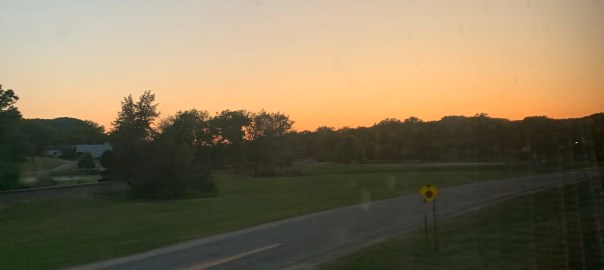
It is Sunday. I am aboard the train back home and it feels appropriate that I leave with an actual setting sun. But this time it is after a final goodbye complete with a hug, a kiss, and so many tears. It is good to love one so much and to be loved just as much in return. To be known and to actually know some one is a gift. Although, neither of those actually make it easier at the end, but I wouldn’t change it for all the money in the world.

I love you, Grandma, forever and always. I will help bring the light, it is okay to rest now.

Stones

Stones that altars made.
Stones with names engraved.
Memorial stones 
That are a sign.
And those that form a line,
Boundary stones.
Building stones,
Precious stones.

And chiseled from the mountaintop,
Stone for tablet law.
And among the sheep,
Five round, smooth stone,
That are swung, then flung.

Stones that are not bread 
Stones for throwing 
Stones for stoning, 
Stones that could cry out. 

The singing stones
That felt the weight
Of colt and Jesus feet. 

Stones for rolling, 
And a cornerstone, 
That will make us stumble.

All for living stones,
Lively, living, precious, 
Temple Stones that do cry out 
And sing.